
"Mr. Iverson's duck calls were of the highest quality during the height of the Tom Turpin and Andy Bowles era."
- Emery Mitchell
E.V. Iverson was born in Reynolds, North Dakota in 1893. He was a first generation American-born Norwegian and the second of six children. As a small boy, he moved with his family to Badger, Minnesota where his father established a general store. This is where he grew up.
In his community on the great fly-way, hunting was a way of life. As a child, he learned how to hunt duck, geese and other wild fowl. By the time he was in high school he was acting as guide for groups of visiting hunters. Most of the men he hunted with at this time voice called with varying degrees of success.
In 1917 he graduated from the United States Naval Academy and began his 29 year career with the Navy. Hunting during this period of his life became a sport he enjoyed with friends whenever there was time. Interested in the idea of a good hand-held call, he experimented with various devices from time to time.
In 1943, now married and the father of two young children, he lived in a rented brownstone house in New York's Greenwich Village. A commander in the Navy, he was attached to the Brooklyn Navy Yard as Damage Control Officer. In 1945, while convalescing from minor surgery in the Brooklyn Naval Hospital, he had access to the hospitals physical therapy wood-working shop. The result was his first hand-made, hardwood duck calls. work on the calls continued when he went home. Setting up a work space in the brownstone's basement kitchen, he shaped, tuned and tested the calls and their inner workings. Occasionally he was interrupted by people walking by on the sidewalk overhead who stopped to ask where the ducks were.
Impressed with the calls design, his wife showed it to the staff of Abercrombie and Fitch's hunting equipment department. A request for calls to sell followed. His calls ultimately came to the attention of New York City's Museum of Modern Art, and their design and beauty won them a place in the museum's permanent collection. Demand for the calls continued to grow. Following his retirement from the Navy after the war, he was able to devote his full time and energy to making calls. Done by hand from treated, non-absorbing hardwoods such as rosewood, ebony, cocobolo, briar and teak; the calls were eventually handled by hunting equipment shops across the United States. (Genie Iverson Clymer, August 3,1985)
In May of 1976, E.V. sold Iverson Duck Calls to Emery and Lucy Mitchell of Novato, California.

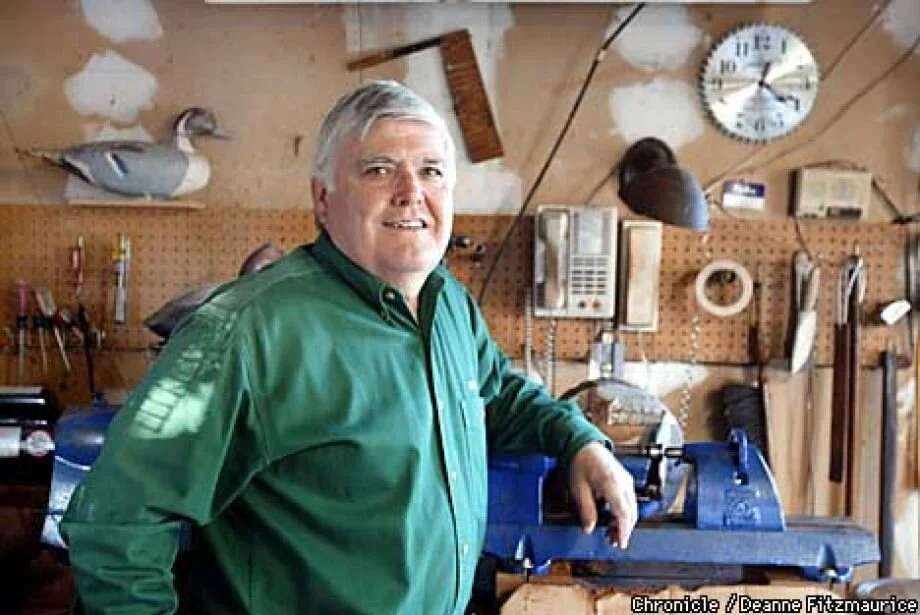
December 1975, Emery’s son Jason picks out a Rosewood Iverson Duck Call with the help of his mom at Abercrombie & Fitch in San Francisco to give to his Dad for Christmas. Emery’s introduction to an Iverson duck call leads him to introduce himself to E.V. Iverson. On that first phone call, and much to his surprise, he discovers that Mr. Iverson has just decided to sell his duck call business. With his love for and background in woodworking, waterfowling, duck calling and fine art he expressed immediate interest in purchasing the business. He is very proud of the fact that Mr. Iverson chose him above many others to succeed him in his cherished work in May of 1976. It was Mr. Iverson's desire to pass the Iverson Duck Call Company on to someone who would love the work as he did, and that is precisely what Emery did.
In 1938, Emery Mitchell is born in San Francisco, California. He spends his formative years near the waters of San Francisco Bay. He carves his first decoy, a drake Sprig, at the age of 10. In 1952 he climbs on a bus headed for San Francisco. He makes his way to a sporting good store and purchases an English Acme mallard call. He learns to use the call from a one-page article in Popular Mechanics magazine. That fall he calls his first duck & becomes incredibly devoted to hunting ducks.
He marries Lucy Ellen McGuinness in 1961. That same year, he attends Chouinard Art Institute in Los Angeles and studies painting, sculpture and illustration. He graduates with honors with a Bachelor of Fine Arts degree. In 1963 and for a little over a decade he works as a commercial artist in several different capacities. He builds a 12-foot duck skiff in the classic San Francisco Bay tradition.
In 1983 he designs and develops Iverson's first Iverson "Timber" duck call. In 1987 he designs, develops and introduces the Iverson World Champion Field Call. That year, thanks to David Jayne, his design wins the World Duck Calling Championship in Stuttgart Arkansas.
In 1988 he introduces the very popular Iverson Super Standard and Super Timber duck calls. In 1998 he is honored by California State Senate Resolution 1532 commending Iverson Duck Calls for its community service.
"Mr. Iverson's duck calls were of the highest quality during the height of the Tom Turpin and Andy Bowles era. In essence, he had continued to carry on that quality and tradition right up to the time he passed the baton to me," said Emery. "When Mr. Iverson turned his duck call making business over to me, I received from him the admonition and the responsibility to continue excellence and to continue to improve the duck calls as did the makers that preceded me. My job was to carry on the quality and the tradition of the work that he loved so much